
Knowing how to measure a pond liner correctly is the most important step before ordering. This guide explains the standard pond liner sizing formula and shows you how to calculate the correct liner width and length based on your pond’s maximum width, length, and depth. Follow these steps to ensure full coverage and avoid ordering a liner that is too small.
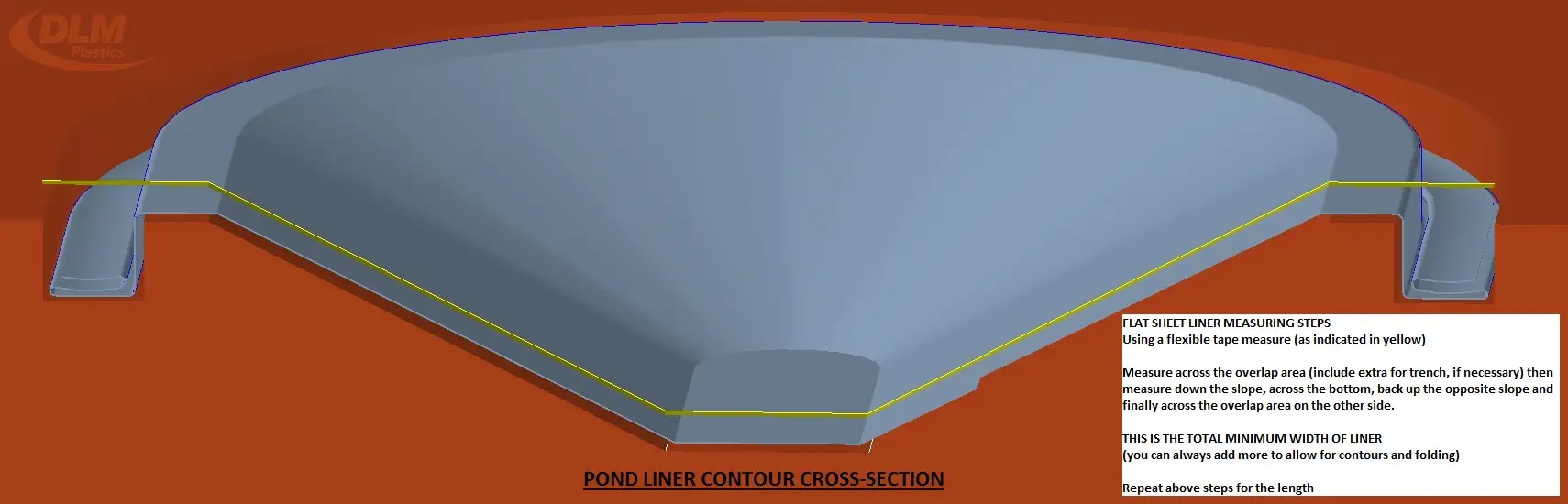
IF YOU ARE UNABLE TO FOLLOW THE CONTOURS, AS DESCRIBED ABOVE, YOU MAY USE THE MEASUREMENT FORMULA BELOW INSTEAD.
To calculate the liner size you need, measure:
The maximum pond width
The maximum pond length
The maximum pond depth (from the top of the bank to the very bottom)
Then apply this formula:
Note # 1 – Yes, the formulas above show the depth being added in twice – this is important.
Note # 2 – The overlap of those extra 2 feet allows the liner to extend beyond the pond edges for anchoring and securing.
If your pond measures:
15 feet wide
20 feet long
4 feet deep (maximum depth from top of the banks to the deepest point)
Your liner should be:
Width: 15 + (2 × 4) + 2 = 25 feet
Length: 20 + (2 × 4) + 2 = 30 feet
You would need at least a 25 x 30 pond liner.
Always round up if your calculation falls between available sizes or contact us for a custom quote.
For ponds with curves or irregular shapes:
Measure the widest point from side to side, across the pond.
Measure the longest point from end to end.
Use the maximum depth, not the average depth.
Apply the same sizing formula.
It’s better to order slightly larger than too small — excess liner can be trimmed after installation.
Always measure at the widest and longest points
Include shelves and ledges in your depth calculation
Add overlap for securing the liner
Never order the exact pond dimensions alone
When in doubt, size up
A correctly sized liner:
Prevents stretching and tension stress
Reduces risk of liner failure
Ensures proper edge anchoring
Extends the life of your pond liner
Choosing the correct dimensions before ordering helps avoid costly corrective action and installation delays.
If you’re unsure about your measurements, contact us before placing your order. Our team can help confirm the correct liner size for your project.
Overlap is excess material added to your liner dimensions that allows the liner to extend beyond the top perimeter of your pond. It is important to have this excess material so that you can cover it with a natural substance like stone or other types of landscaping – this holds the liner in place and keeps it secure around the top.
Not all ponds are the same however, you should add a minimum of 2 feet of overlap (1 foot per side) to your calculations. This applies for most backyard Koi ponds under 1,000 square feet in size. However, larger ponds that use a perimeter anchor trench require additional overlap of up to 5 feet per side (10 feet total).
You must find the deepest point in the pond and measure from a level at the top of the banks or sides down to this maximum depth of the pond.
Tip: Do not use the average depth.
IMPORTANT: Do not measure water depth but the actual overall pond depth from the top of the banks or walls.
Include the full vertical drop from the top edge to the deepest point when calculating depth. Shelves and planting ledges must be accounted for in your depth measurement to avoid ordering a liner that is too small.
Always round up. Ordering a slightly larger liner is far better than ordering one that is too small. Excess material can be trimmed after installation, but a liner that is too small cannot be stretched to fit.
No. Ordering only the surface length and width without adding depth and overlap is the most common cause of undersized liners. Always use the full measurement formula before placing your order.
If you’re uncertain, contact us before ordering. We can review your pond dimensions and help confirm the correct liner size to prevent delays or returns.
18 x 20 Flat Sheet Pond Liners
25 x 30 Flat Sheet Pond Liners