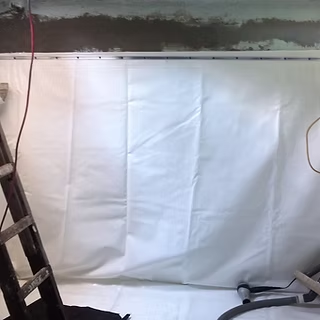
DLM Plastics has been a leading manufacturer of cistern liners, Rainwater Harvesting liners, catchment tank liners and other potable water containment applications for well over 30 years. Our liners can be used in either new installations or they can be retrofit into existing tanks to provide an impermeable barrier which will eliminate leaks caused by cracking or porous surfaces inside your tank. Our engineers have become quite adept at finding solutions for such irregularities as multiple chambers with flow-throughs and overflow notches, support columns, pipe penetrations and sump wells.
DLM Plastics has been a leading manufacturer of cistern liners, Rainwater Harvesting liners, catchment tank liners and other potable water containment applications for well over 30 years. Our liners are used in both new installations and retrofit projects to provide an impermeable barrier to eliminate leaks caused by cracking or porous surfaces inside your tank. Our engineers have become quite adept at finding solutions for such irregularities as multiple chambers with flow-throughs and overflow notches, support columns, pipe penetrations and sump wells.
DLM offers several potable-grade material options in both film (single-layer) and supported (multi-layer with rip-stop scrim) all of which are NSF-61 approved for drinking water installations. These materials are the “go to” choice for whole-house water systems.
We carry numerous options in both film (single-layer) and supported (multi-layer with rip-stop scrim) styles and all are based on the application:
General Household Use (non-drinking), Irrigation , Livestock, Fire Suppression Systems, and General Purpose.
We weld a hem at the top of the liner wall to provide a double-layer for added strength. The installer holds the liner up to the appropriate level, holds a batten strip in place and then screws directly through the batten and liner into the wall.
We supply a PVC track that is pre-hung in the tank by the installer. Then, we weld a molded lip at the top of the liner wall that simply hooks into the track and the liner is installed. This is similar to the way an inground swimming pool is hung.
Typically used in open-top tanks, we add an extra amount of material at the top of the wall that is either laid-flat onto the top surface or folded over the top of the wall.